


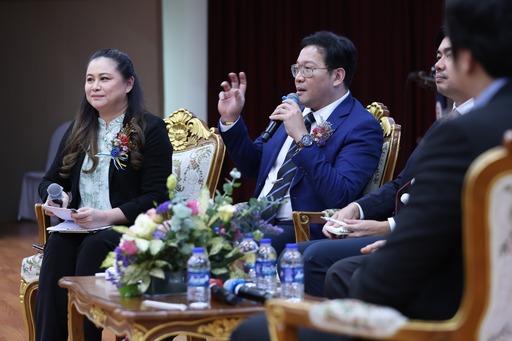
The panel discussion titled “From Data to Opportunity: Tracing Toxic Substances… Reviving the Kok River” was held on August 29, 2025. It featured Professor Dr. Siwat Pongpiachan, Chair of Future Earth Thailand, a faculty member, and Director of the Research and Development Center for Disaster Prevention and Management, alongside experts from various sectors.
This academic forum was organized under the project “Management of the Kok River Basin Contaminated by Toxic Substances Using Geo-Informatics and Advanced Technologies for Environmental and Health Security.” The project is led by Professor Dr. Siwat Pongpiachan and is supported by the Science, Research and Innovation Promotion Fund (TSRI Fund) through PMU-B for the fiscal year 2025. The initiative aims to disseminate and exchange knowledge and experiences among experts, academics, and stakeholders dealing with local issues, focusing on the application of scientific data and advanced research to address pollution and chemical contamination in the Kok River and Sai River, as well as to develop sustainable watershed restoration approaches.
The forum brought together distinguished speakers from diverse fields, including:
• Associate Professor Dr. Patcharee Pribadiwech, an expert in analytical chemistry from Mae Fah Luang University
• Dr. Suttipong Wannapaiboon, a specialist from the Synchrotron Light Research Institute
• Mr. Ekaphol Eakkarungruangroj, an expert from the Disaster Communication Development Center
• Assistant Professor Dr. Niorn Sirimongkollertkul, a specialist from Rajamangala University of Technology Lanna
• Mr. Sondhi Kacharath, an environmental scholar
• Mr. Phattharapong Leelaphat, a Member of Parliament from the People’s Party
In addition, Dr. Jitti Mangkala Siri, Deputy Director of PMU-B, joined the discussion session titled “Moving Forward… Toward Sustainable Restoration” alongside the speakers. The discussion highlighted that contamination by heavy metals and arsenic in the Kok River has caused widespread impacts on public health and the environment. Such contamination may arise from both natural causes and human activities, such as mining, and has escalated into a complex transboundary pollution issue.
Addressing this challenge requires international cooperation, integrated negotiations among state parties, and the use of scientific data and research to monitor and analyze the situation, as well as to formulate appropriate short-term and long-term solutions. It also calls for collaboration across all sectors, including higher education institutions, specialized research institutes, and local organizations.
During the discussion, Dr. Jitti emphasized that:
“The issue of toxic contamination in water resources has long been a challenge for Thailand. In addition to strong policy measures from the government, collaboration with researchers and academics is essential to conduct timely, rapid, and reliable studies. This will enable the use of scientific data to develop effective policy recommendations for appropriate and efficient problem-solving.”
He further noted that:
“These issues are not limited to people in Chiang Mai or Chiang Rai provinces; they are national concerns. The research led by Professor Dr. Siwat will provide a model for analyzing root causes and addressing water pollution contamination, which can also help prevent potential public hazards in the future.”
”
Photos


